(noun| a pleasant smell that frequently accompanies the
first rain after a long period of warm, dry weather)
One of my favourite words. Both for its meaning and its
sound. For what it evokes in reality…and in its symbolism.
Here in Perth, it is a Petrichor kind of day today. Whether we
commuted to work or stayed home, there’s no way to miss it. If you ask me,
there should be a national Petrichor Day, especially here in Australia. (Imagine
my joy when I discovered that the word was coined in 1964 by two Australian
CSIRO researchers, Isabel Joy Bear and Richard G. Thomas, for an article in the
journal “Nature”.)
A day of gratitude. A day to practise the art of doing
nothing much. A day to acknowledge that it’s the little things that matter. The
quiet evenings…the perfect Spotify playlists…the mood lights in the living room….
the essential oil diffuser in the hallway…the mindfulness in doing a pencil
sketch…the calmness of ditching Netflix and finishing that book.
National day or not, I bought flowers to celebrate it.
Flowers that remind me of raindrops. Light, breezy, dreamy. And I have big
plans to do the little things. I will sit and sip on my Darjeeling… listening
to the leaves rustle, the pitter-patter of the rain on the metal
roof, the water trickling down the eaves, as the wind whooshes through
the night. (Gotta love onomatopoeia!)
And while Petrichor is not a traditional example of sound symbolism
(phonaesthesia) or onomatopoeia….for me, it is evocative of a sensory
experience so strong, that it could almost qualify as one. Doesn’t the
"stony," sound of the word "petri" (originating from the
Greek “petra”) make you almost smell that earthy scent the word stands for?
Speaking of onomatopoeia, turns out that the Japanese
language relies much more on mimetic words (known in linguistics as ideophones)
than the English language. “Known popularly as onomatopoeia, these words do not
just imitate sounds but also cover a much wider range of meanings…” (Wikipedia).
And the most popular mimetic word in Japanese happens to be “doki doki”, which is
a term used to mean “the heart pounding”. So similar to “duk duk” in Bengali,
don’t you think?
Anyway, I better stop rambling now. I have a lot of nothing
to do today.
Wishing everyone in Perth a Happy (unofficial) Petrichor Day
today (and to anyone else who hasn’t enjoyed a day of rains but doesn’t mind
celebrating it).
In the debate between language (politeness/manners/decorum/political correctness) and intent, I mostly side with intent. How often have we said the meanest words to the people we love the most (in anger or frustration or just because we had the audacity to take them for granted)? And how often do we end up using the politest/sweetest words with people we barely tolerate (for social decorum, professional courtesy or simply as “small talk”)? Too often, is my guess. Intent matters more. We may mean well but be unable to articulate it or worse still, communicate just the opposite. What’s important, I think, is that we mean/intend/wish well.
But in some cases, I choose to contradict myself. When it comes to fundamental subjects where the language we use holds the power to perpetuate stigmas and dogmas and stereotypes and cruel myths or any disrespectful, reckless, entitled, discriminatory, oppressive, dehumanizing practices and mindsets in general. For these societal and humanitarian subjects, just meaning well isn’t sufficient. Because the language used can completely nullify years of research and progress and make us inadvertent tools of regression. These issues have existed forever, you may think. True. They have. But they continue to evolve because our understanding of them is being nourished and fine-tuned with education and research.
And while no one person can (or be expected to) be an expert in all such matters, what’s stopping us from consciously improving our awareness? If we can stay abreast of the latest smartphone models and features…of the latest fashion trends…and even current news, no reason not to dive a little deeper into subjects that may not be “trending” but are never irrelevant. Because these matters matter. And so does our language.
Last year, I had the opportunity to look into how our language frames the subject of masculinity (and its stereotypes). Today, in preparation of a great initiative by a dearest friend (more details coming soon!) and the release of a movie by one of my favourite Indian actors (about time!), I looked up the language guide for talking about disability (a resource from PWDA Australia, and written by people with disability “to assist the general public and media outlets in talking about and reporting on disability”). To be honest, I started looking into it because I wasn’t sure what words were considered informed and respectful when talking about people with disability. In fact, I wasn’t even aware that the preferred term is “people with disability”, because many other words have crept into popular vocabulary. In reading this, I know now that many euphemisms that we commonly use (e.g. special needs, differently abled, with different abilities), are “at best condescending…at worst, they are offensive”.
If you have the time, please read the guide. If not, here’s a summary you may find useful:
Where possible, ask the person how they like to be described. If in doubt, use person-first language or refer to that person by name.
Reference a person’s disability only when it’s relevant.
Focus on the person, not the disability.
Avoid descriptions that suggest pity. Terms such as ‘suffers from’, ‘afflicted by’, ‘stricken with’, and ‘victim’ imply a person with disability is suffering or has a reduced quality of life. Use neutral language, instead. For example: ‘He has muscular dystrophy.’
Don’t describe a person as ‘being’ their condition – for example, do not use ‘Vanessa is paraplegic’ or ‘Karim is autistic’. Instead using ‘Vanessa has paraplegia’ or 'Karim has autism' is correct.
Don’t describe a person without disability as “normal” or “able bodied” or “of sound mind”. Instead, saying “person without disability” or “person is neurotypical” is correct.
The key takeaway for me, from reading this is “Paying attention to the language you use when talking about people with disability is not about being politically correct, it’s about being respectful.” And coming back to the language vs. intent debate, I’d like to think that most of us intend well. But about time we back that intent up with the choices we make about language.
(This article was the editorial for Oikyotaan, the Durga Puja Magazine of the Bengali Assocoation of Western Australia. You will find the original here.)
Why did an incident that happened at 1, Khudiram Bose Sarani, Bidhan Sarani, Shyam Bazar, Kolkata, West Bengal 700004, India (commonly known as R. G. Kar Medical College and Hospital) lead to…
A candlelight vigil in King’s Park, Fraser Ave, Perth WA 6005, Western Australia… A peaceful rally in Simpson Plaza, 6101 Frisco Square Boulevard, Frisco, Texas, USA… A silent protest at Newcastle Civic Centre, Barras Bridge, Newcastle Upon Tyne, England… A march with posters and guitars at Amsterdam Dam Square, 1012 NP Amsterdam, Netherlands… A series of gatherings and protests at GN 29, Sector V, Salt Lake, Kolkata 700091, West Bengal, India (Shastha Bhavan)… A month-long (and longer) period of unrest where thousands of people across Kolkata are stepping out of their daily routines, embracing the disruptions, delays, inconveniences and losses that come with mass protests… And hundreds of other displays of solidarity across the globe… demanding justice ….?
Because it makes our blood boil and our hearts weep. Because it’s a violation… of a woman, of human rights, of law and justice, of democracy and freedom, of everything a civilised society should represent… Because it happened at an institution that is meant to provide care for the sick and injured. An institution that, at the least, should provide safety and security. Because a crime was committed, not on its own, but to hide several crimes that happened before it…and to cause several more to be committed after it. Because it exposed rottenness like never before. At every level. Because it is getting muddier every day. And the promised light at the end of the tunnel is getting farther away. Because justice is demanded. But even hope is being denied. Because it’s personal. For each one of us.
In that context, what happened at R.G. Kar Medical College and Hospital is not only a rape and murder. It is, in my opinion, nothing less than an act of terrorism1.
Many theories, opinions, questions and facts have surfaced regarding the “why”. Why was the crime committed? Why is the crime being covered up? Legal, political, moral, psychological, societal angles have been discussed and debated, extensively worldwide. I am neither an expert nor am I able to keep up with the new information that media is feeding us every day. But what I have gained over the last few weeks is a different perspective and a bit more awareness.
Only recently, in talking to a friend, I associated rape with a behavioural or mental disorder. What else could cause someone to act so brutal? But turns out, although some rapists may have a psychological disorder, it is not the case for all. While motives behind sexual assault vary and are difficult to quantify, according to several studies, rape is less about sexual gratification but more about dominating people. Most experts in the subject believe that “rape nearly exclusively has to do with issues of power and violence.”
In 2016, the United Nation’s Secretary General presented a report on “Conflict-related Sexual Violence”, where the council recognised sexual violence as both a “tactic of war and a tactic of terrorism…” The report mentions: “Women and girls face a heightened risk of sexual assault when performing livelihood activities such as collecting firewood, grass or water, going to markets or tending fields, as in the Central African Republic, the Democratic Republic of the Congo, northern Nigeria, South Sudan and the Sudan (Darfur), or when herding cattle, as in remote areas of Myanmar. In the Central African Republic, rape has been used to punish women of a certain religion for trading with members of another community…. The ever-present threat of sexual assault compels women to lead highly circumscribed lives in militarized zones, as seen in eastern Afghanistan or northern Sri Lanka. Moreover, high-profile women across a range of professions have been subjected to sexual harassment and humiliation aimed at silencing them.”
It may seem like a girl tending fields in Nigeria or a woman collecting firewood in the remote areas of Myanmar have very little in common with an accomplished, female doctor in a metropolitan city like Kolkata. But surprisingly, the context and motivation of the crimes they were subjected to are the same! In all these cases, “sexual violence served as a tool of social and moral control to relegate women to the private sphere and to punish perceived ‘countercultural’ behaviour.”
Unfortunately, in some cultures (including ours), patriarchy and dominance are expressed through a kind of “dehumanization” in which women are seen as inferior to men and sexual assault as a way of keeping them in their place. So what we are dealing with (sexual violence) is not necessarily triggered by a clinical condition but a societal/cultural pre-conditioning. Which means, there is hope. It can be reversed. Slowly but steadily…even if it takes generations, we can teach our young men that stereotypical ideas of masculinity are as harmful for them as it is for women and society in general. There is no glory in exhibiting violence, dominance, emotional illiteracy, sexual entitlement, and hostility to femininity. That women are not objects to be controlled and dominated. That masculinity is not about having to hide your emotions. In fact, it is healthy to be in touch with your emotions to the extent that you know how to deal with them. If we want boys and young men to live happy and fulfilled lives and be caring and respectful in relationships with women, they need role models who show them that “being a good man is really just about being a good person 2”. It truly is a shared responsibility…and it starts at home.
Until the mindset changes, here’s hoping that the worldwide wave of “Justice for R. G. Kar” washes up the perpetrators to the shore….and justice is indeed served to prove that nobody is above the law and no woman, child or man is beneath it.
——————————————————————————————————— Sharod Shubhechha from the entire team of Oikyotaan 2024 (volunteers, contributors, sponsors and committee members). I hope you enjoy the contributions of the writers and artists, which will take you on a journey in Max’s Flying Car, from South Africa to Jaldapara via Ballarat! Tighten your seatbelts, as there are Shark Attacks and Nazi Attacks along the way. You may spot a Girl in the Lotus Dress, wave at three Indo-Aussie youngsters who take pride in their culture or hear about a heroic boy’s Sacrifice. But most importantly, you will find out why Ma Durga Likes Rainbow Ice Cream.
P.S. On this article, I have shared a few recommendations from a health promotion foundation, which has done extensive research on masculine stereotypes in Australia. Our hearts are heavy this festive season, but I hope we can be inspired by these recommendations to start having these important and productive discussions with our loved ones.
If childhood is about finding joy in weird and the outright
disgusting things, then we nailed it as the 70- 80s kids in India!
Kali Pujo and Diwali had so many beautiful and delicious
traditions, food and memories for us. But the one that is engraved most deeply
in my mind is probably something that is banned now in India (not sure, though).
The kakus and dadas took care of the “rocket baajis” (we
kids weren’t allowed to light those up or even go too close to these
“hazardous” firecrackers. Their bodies would be in “high alert”, as they placed
these in glass bottles, then light a match, and with great precision (and what
seemed like a particular geometric angle), they would light the tails of these
rockets that would then soar up and turn the night sky into something magical.
As kids, this scene would be aspirational. No, I don’t mean that we would turn
philosophical at the sight of the night sky and aspire for new heights. And when
we said “ami boro hoye rocket jalabo”, it didn’t have anything to do with career
aspirations in astronomical or aeronautical sciences. We would simply mean that
one day, we would light those hazardous firecrackers ourselves, while everyone
else would watch us in awe.
The didis often
guarded and managed the “chorkis” and “haat chorkis”. Younger dadas lit the “kaali potkas” (much to
everyone’s annoyance). We kids were left with the “rong moshals” (good fun),
“tara baaji” (too simple) and “electric taar” (test of one’s patience!).
Right when we have had enough of these comparatively safe
and relatively boring firecrackers, we would signal to one another for taking
the game up a notch. With our eyes gleaming brighter than some of the
fireworks, we would quietly move to one corner. The unsuspecting might think we
were planning a crime (or sneaking out for a cigarette, like some of the adults
did). But, no. We were good kids (mostly 😉).
From a few kids’ bag of firecrackers, out came the notorious
“shaap baaji”. Not all of us had these, as some parents would refuse to buy
these smelly, pollution-inducing little devils. If you hadn’t “experienced”
them before, you would never guess how these tiny black “hajmola” type discs
could possibly turn into such weirdly satisfying black snakes, that “grew as
they burned”. Things usually diminish or shrink when burned. But not these
wondrous “golis”. They were like a phoenix of sorts (although, I didn’t quite
know what phoenixes were, back then). They would rise from the ashes…but also
turn into ashes. And while they did that, they would make everyone choke and
cough and suffocate with their pungent smell and thick, black smoke. A few tiny
black heads gathered in a circle, with a thick black smoke emerging from the
centre – that’s what the scene would have looked like from a distance!
“Orey tora bondho korbiogulo?”, some adult voices would float in. We would chuckle, ignore, and
light the next one up. I think it gave us a high. Or it could simply be “guilty
pleasure”.
I now wonder how something so weird and smelly, be such a
source of such unadulterated joy? And then I remember that we were the same
generation that was obsessed with “hojmis” and “churaans” and “bonkuls” and
“electric noon” and “jhaal chips” (that burned our tongues). Shockingly sour or
hot, and unapologetically mixed and moulded into mounds by dirty hands of the
roadside “thelawala”. We truly were the generation that had an “acquired taste”
for the weird, dangerous, harmful and often disgusting….
Mumlette is not omelette mispronounced. It is an altogether
different dish (and memories associated with it). Omelette is the fancier cousin…the
one who visits Kolkata (from abroad) once a year and stands out with their accent and need for toilet paper.
Omelette is the cheesy perfection that chefs make for you at restaurants
(or what you have “learnt” to make at home), usually for breakfast or a healthy
lunch. Fluffy, gooey and often loaded with veggies we may not have grown up eating
(mushrooms, olives, peppers), it is folded a way that radiates a certain level
of mastery in the kitchen.
Mumlette is not cheesy like that (literally or otherwise). No,
sir. It is totally comfortable with its rough edges (literally) and that uneven
half-moon fold. Often cooked in Bengali households with “shorsher tel” (mustard
oil), it is a go-to snack/meal, for anytime of the day. Be it the unannounced
guest at 7pm or the “gaaner didimoni” (music teacher) at 4pm on Wednesdays or “onker
sir” (Maths tutor) at 9am on Saturday mornings, or the common “Ma khub khidey
peyeche” (Ma, I am hungry) after school….a mumlette is the unsung hero of a
Bengali household, next only to Maggi (especially in Kolkata). Or such is my memory from my growing-up
days, back in the 90s. I am sure the healthier olive oil has replaced the
mustard oil in most kitchens in India now….and pastries/cookies/puffs/chicken
nuggets are the go-to snacks these days.
But today, I ditched the olive oil, cheese and mushrooms to
make a proper mumlette. With red onions and green chillies (coriander leaves
would have made it perfect, but I didn’t have any), my mumlette was just the
imperfect perfection I was aiming for. And yes, I can vouch for its teleporting
powers. I could almost hear my “gaaner sir” play the harmonium and see Ma walking
into the room with a tray, carefully balancing the tea and biscuits on one
side, and a plate with the mumlette on the other…
This month, 15 years back, I arrived in Perth…with big
dreams and a very small bank balance. Having wrapped up things in India, paid
off student loans, packed our lives and belongings in four suitcases…it was
like hitting a reset button on our lives, like many immigrants.
The house we rented on a noisy street in Belmont was blue. Literally.
The garage door was not automatic. When we came home every night, we would get
off the car (a heavy door needed two pairs of hands), unlock the door, push it
open while it made that metal screech that makes you cringe, hop back into the
car, drive in, get off the car, close the door and finally lock it. An insignificant
detail, one would think. But it kind of summed up our life then. A bit messy,
screechy and lacking in comfort but not in zeal.
Many of you know the story of the yellow flowers in our rental home. Some of you have read about why we chose Perth in the first place (and
why we love it so much). But very few know that a payment of around $12-$15 (three
coffees and one fries, I think) on our debit card was declined in our first month
here. We had “insufficient funds” after paying the bond money on our rental
home, buying groceries and making a down payment for our car. So, until Amit’s
salary came in (in a couple of days), we could only hope we would survive
without any expenses (our Transperth cards thankfully were loaded…so life would
go on).
Those were the days we finally saw the point in the mental maths
classes from our school days. Converting AUD to INR in our minds, for pretty
much everything we bought (or could not buy), jogged our brain cells like
nothing else did. At the butcher’s one Thursday (late night shopping), we were
surprised (and delighted) to find how cheap mince meat was (after the said
mental maths exercise). We bought 2 kilos of mince (and some other essentials),
pushed our shopping trolley to the farthest point we could (without taking it
home), and walked the rest of the way home (our no-car days). Back home, we
cooked the mince with Jamie-Oliver-esque joy and passion…neither of which lasted long. After our first spoonful, we almost lost our teeth (with no private health
insurance still, losing teeth would have been a terrible tragedy). We bit into….what
felt like….gravel. Why on earth would mince meat have that many bones?! What appallingly
bad quality, for a country that’s known for its dairy and meat, we thought!
Turns out, we had bought “pet mince” (mince your dog would
enjoy thoroughly). That explained why it was so cheap. That would also explain
why we could never walk past that butcher without grinding our teeth, even
months after this incident. But we lived to tell the story :).
15 years on, our mental maths is not so great anymore (we no longer
convert between currencies). We have discovered mince meat meant for humans. We
have lost teeth and claimed dental benefits from our private health insurance.
We have a non-blue home with an automatic garage door (life’s little joys). We have
“sufficient funds” for coffee and fries (mostly). But our “meatier” life stories
are mostly from 15 years back.
Friends kept me
going in my darkest days. My friends, of course. But also the TV show.
Having just lost Ma,
my world had suddenly shrunk. I was stuck in my thoughts and did not step out
of the TV room much. Seated in my trusty recliner, I watched Friends again…episode
after episode…season after season. With my eyes on my favourite TV characters, my
mind comfortably drifted. To memories from the recent past….and those of my
childhood. The lines between real and make-belief blurred away. And while The One with the Evil Orthodontist was nowhere close to any personal experience
(thankfully), I was transported to “the one in which Ma took me to the
dentist”….” . And then, one by one, episode after episode, Ma made an
appearance. “The one in which Ma came to
visit me in Australia” ….. the one in which Ma made malpoa”…”the one in which
Ma was in the hospital”. Wait, close that tab, open a new one. ”The one in
which Ma acted in a pujor natok”….”the one in which Ma posed with Boudi
for photos in our Puri trip”….”the one in which we went to Mamabari with Ma”…”the
one in which Ma packed Baba’s lunches”…”the one in which Ma braided Shanaya’s
hair”…”the one in which Ma tried to get up from her wheelchair in her
physiotherapy session”. No, close that too.
With my mind working
overtime, I needed white noise…to fill the time it took to close a tab and open
another. But not any type of white noise would do. Not music (I needed visuals)
….and not anything new (couldn’t let new voices and faces into my room or
thoughts). I wanted the familiary and comfort of people I love. People I trust.
On screen too, as in real life.
Friends was the only
choice.
I was with them on
the couch at Central Perk. They did their own thing. I did mine. But being
close to them was important. I needed to be left alone. But not totally alone.
They got that.
I did not skip the
title credits like I usually do…. not for a single episode. I let it play, over
and over again. For “I’ll be there for you..” never sounded more soothing. They
meant it for me. And I believed them.
Losing a mother is like losing a part of you. For you were
once a part of her, you see. It’s looking at the veins at the back of your
hands and realising how similar they are to hers. It’s unconsciously humming a
song you don’t even like, and remembering that she did the same when she came
out of the shower and went straight to the thakur
ashon to offer nokul dana, jol and dhoop (with a towel still wrapped around her hair). It’s picking up
a brown nail polish at the shops, and keeping it back…because brown was her
favourite colour (and nail polish her favourite indulgence).
It’s also losing a part of your identity, because nobody
knows those minute details from your childhood like she did. One may know how
you got that scar on your forehead, but only she can tell you how tight you
held her hand at the doctor’s during the stitches (and begged for an ice-cream,
specifically in a cone, later). An aunt or a neighbour may tell you how unique
your dresses were, but only she can tell you how she bought the fabric and lace
from that corner shop in New Market, and had it made as per her specific design
at the Ladies Fancy tailoring shop.
It’s been four months and six days since I lost Ma. Well-wishers
have suggested that I take the time to grieve. Friends have advised that I
should write about my thoughts. But I didn’t know how to. What words could
capture something that was so intense, and yet hidden in the most mundane
things? How do I explain the sudden anxiety in the middle of the night, when I
realise I haven’t called her that day? Or when I ask my eight-year-old to pose
in her new dress, so that I can send the photo to Dida? Grief, you regular yet random, fleeting yet constant thing…how
will I ever capture you in words?
Grief is like a filter. It casts a different layer to every occasion
– happy or sombre. It changes the colour of memories. It makes the happiest of
them slightly damp. It leaves every present moment only a tad bit incomplete. The
little achievements….the proud milestones…the joyful moments…almost perfect,
but never quite. It’s not a moment in time. It’s a way of life. The life before
a loss….and the life after.
And this was my first Mahalaya in my life after. Mahalaya –
the day, the feeling, the smell, the sounds! All changed forever…yet again
after 20yrs (since Baba breathed his last). The first time when the
significance of the day was more in the Tarpan
than in the Chandipath. The first
time when the feeling of “Ma aar nei”
was stronger than “Ma asche…”.
Anjan Dutta (and Bela Bose) fans (and I am a fan too of the song, btw), pardon the silliness...but I wonder if "Bela Bose - Flipped" would sound something like this... ;)
P.S. Written in a silly mood (so not meant to be taken seriously).
‐--------------------------
"Bela Bose - Flipped"
Chakri ta ebar cherey debo, ogo shuncho
Eto khatakhati ar je poshachchey na
Dhaar dena gulo ebar tumi ekai dekhe nio
Nota pachtar chakri ar korbona.
Chakri ta ebar cherey debo, ogo shuncho
Ekhon ar keu atkate parbe na
Ghoreybaairey dudik shamliye, chollam to koto
Baki jibon ta ebhabe katabo na.
Eta ki 2441139?
Ogo koi tumi...parcho ki shunte?
Lunchbreak jachchey furiye
Oi boss elo bujhi firey.
Debo na kichutei ar chechatey.
Shopno ebar hoye jabe ogo shotti
Etodin dhorey eto opekhkha
Nota pachtar ei rat race e
Bodhdho jiboney bondi dujoney
Hapiye gechi roj ditey e porikhkha
Ar kichu din tarpor amar mukti
Grihokormey nipuna hobo shotti...
Shada kalo ei jonjale bhora miththey kothar shohorey
Most corporates turn their philanthropic activities into
marketing campaigns. I have no issues with that, as long as the philanthropy
continues…
When I was in Year 5 or 6 in school, Maggi had sponsored
some such initiative. Something to do with educating underprivileged children
(I can’t quite remember). But what I do remember is that they gave all the
students a packet of Maggi each, as a token.
For those who know my love for Maggi, this may not come as
a surprise. But I went home that day only with half a packet of Maggi. The
other half? Well, I ate it of course. Uncooked. In class. Sneakily, without the
teacher’s knowledge. How easily the Horlicks tag line- “ami to emni emnii khai”, could be applied
to this product too, I thought!
The other half, Ma cooked (in 2 minutes, as they claim). But
I ate it in less than a minute, am sure.
So, it pleases me to
see that I have given birth to (or raised) another fan of the noodles. She happily
eats the Masala variety (my favourite), and does not find it spicy (which is
strange for someone who plays the “too spicy, mummy” card, way too often).
So yesterday, back home from school on a raining afternoon,
we slurped our bowlful of steaming, hot Maggi. As I let her eat some uncooked
strands of noodles (much to her amazement and joy), I smiled at my new-found partner in crime!
You are 7 now. Taller, Talkative, Terrific! And to add another feather to your cap, you have dealt with the crisis around COVID-19 incredibly well. We have stayed home (or consciously adhered to the isolation guidelines, to do the responsible thing) for weeks/months - over March to June 2020. We are lucky here in Perth to be able to ease the social restrictions sooner than most other countries/cities in the world who are still battling the rising curve. But it must have been difficult for you, given the social butterfly you are! You took it really well, and never complained. I am proud of how positive, energetic and cheerful you have been through this all. Not a single meltdown (although, I myself had a few)!
We took to art (painted, made COVID-themed posters and family hand-print collages, wind chimes out of bangles, a peacock out of leaves, and even a picture of the night sky for Daddy's desk on his birthday)....
music and dancing (there was a party in our living room almost every day, as you asked Google to play your favourite songs)....
role-plays (we set up pop-up restaurants in the backyard and served pancakes and ice-cream for brunch!)...
DIY toys (Daddy made you a kitchen out of cardboard boxes, and a cool little camera...Mummy sewed a dress for your Barbie and made Easter Bunnies out of socks...and you made Play Doh animals and birds)...
Google 3D animals, ranging from tigers to giant pandas (who looked quite comfortable in our living room)...
star gazing with our new telescope (bought at the Perth Astronomy Fest 2020)...
video/Zoom chats with family and friends (and even virtual birthday party and cake cutting for Daddy's birthday)...
reading and story-telling (and making video clips of jokes you read out from your new-favourite "The Treehouse Joke Book")...
walks around the neighbourhood (spotting the teddy bears and rainbows people left at their windows to lift up the spirits...and the most gorgeous pink skies at sunset)...
cooking and experimenting in the kitchen (especially the Dalgona Coffee that became "viral", and Daddy's signature goat curry and pulao)...
science experiments (of invisible drawings that reveal themselves in water, and shape shadow on walls)...
Lego competitions (where Daddy built a bridge he named "Poku"and you built a whole city, with a school, playground, hospital and even a church!)...
gardening and home-decorating (we planted a new yellow-flowering plant that we can see from the kitchen window, while Daddy took to grafting roses)...
homeschooling (which was bitter sweet - some days were fun, and some were stressful, as Mummy was still working full time, and had deadlines to meet!)
backyard cricket (where money was always involved!)...
writing letters to our friends in the neighbourhood (and receiving replies in our letter boxes, because we couldn't meet them in person)...
makeup and manicures (our nails have never looked so good before!)...
TV and movie nights with pop corn (Nadiya Hussain's cook shows were our favourite, and we even tried a few recipes like beetroot pasta, orange baklava, soda bread, peanut butter chicken casserole)
candle-lit dinners (because, well...one day, there was a power cut around dinner time.. and one day, because we just felt like it!)...
radio shows (yes, Mummy even did a quick interview with a radio station in Kolkata, to share what the COVID situation was in Australia!)
and a pet (we brought home Shelly, the snail).
Turns out, the best thing we got out of this crisis was memorable time with the family. I hope when this is all over, and the world has found a way to defeat this virus, we can look back on these days, and remember how we survived a pandemic, together as a family. Most of all, I hope we continue to be grateful for our blessings, big and small...and never take anything or anyone for granted.
"Mummy, I'd like to have a pet snail", she said one day during the lockdown period.
Surprised (but relieved) that she had lowered her demand from a dog to a snail, I play along. "That's a lovely idea for a pet", I say. "If you can find one in the garden, you can keep it. We'll feed it leaves and scraps."
Excited at the prospect, she starts to spend considerably more time in the garden, looking for a snail. Better than being in front of the TV, I think.
The search continues for a few days, but no sign of a snail. She comes back with an ant instead. "Look who I found, Mummy! She's so pretty. I'll name her Curly!" (because the poor ant had curled up in fear by then).
So Curly finds a home in a plastic takeaway box, and is placed centre-stage on our dining table. It was almost lunch time by then, and her Dad had made his signature Biriyani (her favourite too). When we weren't watching, little fingers placed a fat grain of saffron coloured rice in the box. "There you go, Curly. Eat some biriyani."
Now, we had always joked to first-time visitors that we weren't great cooks, but nobody who ate the food we cooked, had died. We will never be able to say that again.
Because Curly died.
Whether it was from pure joy (from the best meal of its life) or from the constant talking or frequent touching...we will never know.
But tears were shed. Prayers were said. And a burial in the backyard followed.
Pet-less again, the search for a snail started anew. Days later, hopelessness sets in. "There are just no snails in our garden, Mummy". But she remembered seeing snails in one of our friend's gardens. "Can you ask them to catch one for me?"
"Of course not!", I say, imagining how that conversation would pan out. "Hello, how are you? Calling for a small favour. Could you please catch a snail for my daughter? We promise it will get a loving home at ours".
I cut that imaginary conversation short in my head. Especially after Curly's demise, I wasn't sure if I could promise anyone a good home anymore!
But I did have that conversation in reality. And the friend did not hang up on me. In fact, she called back a few days later with news. She had managed to catch a snail during one of her evening walks!
So we rushed to her house (like rushing to the hospital at the news of the arrival of a new baby!). And what do we find there?
A snail with a birth card and gender announcement! It was a girl! Miss S was finally a big sister!
I had happened to mention to my friend that Miss S had planned to call her snail (if she found one), Shelley (obvious reference to its shell, duh!). My friend remembered!
And so, with a heart full of gratitude, and hands holding a box with her "little sister" inside, she comes back home.
Days pass. We make Shelley a home...with soil, a rock to climb on (for the view of the garden), a leaf to sit on, and a food dish where we leave fruit and veggie scraps. We read her stories (preferably one with snails in it) after school.
Shelley soon earns an adjective. "Shy Shelley", we start to call her, as she never comes out of her shell to show us her face (or any other body part).
Until today.
Looks like she has finally warmed up to us. She lets us watch her, while she eats an apple!
And while tomorrow marks one month since we got her home, we celebrate today, when Shy Shelley isn't so shy anymore...
Truth be told...I am not coping with the anxiety and stress around the current COVID-19 crisis too well. Working from home for the last one week, while having Miss 6 at home too, the lines between work and home have become blurry. I have deadlines to meet...and a child to home-school. I want to do both well. The dishes and laundry, the cleaning and cooking, the work video calls and family WhatsApp groups...I want to ignore none. I am worried sick about Ma at home (who is practically disabled, and dependent on others for the simplest of things). The sleepless nights have given me a stiff neck. I need to switch off, but I can't. I need a break from looking at the screen (of all sizes). I need sleep. So, today, I took the "day off".
I woke up earlier that usual. In fact, I hadn't really slept at all, with late-night phone calls from Ma. I must make most of my day off, I thought. I made breakfast for the family, instead.
Simple, easy breakfast. Not good enough, I guess. Perhaps I should have made something special. After all, it's my day off. But I'll make up for that later. For now, let me get a few loads of washing done.
Meanwhile, the little person was up. I better spend the whole day with her, doing fun stuff, and catching up on school stuff. After all, it's my day off.
So after breakfast, we spend an hour or more making a wind-chime with materials we had at home, then writing about it, and photographing it with my little artist. That reminds me! Her school has been sending us online materials to do at home. So next, it was school work...spelling, writing, reading, maths. Let's make it extra fun, shall we? After all, it's my day off.
The neighbourhood mums group has started a "teddy bear on the window" initiative. So that when kids walk past houses, they see these teddy bears and smile. With little or no interaction with the outside world, it's a great idea to keep their spirits up. So, we went about finding a teddy to put at our window. But wait, the window has cobwebs, and dust. So I clean it first. As I already have the duster in hand, might as well dust the house. After all, it's my day off. All the dusting has made the floors too dirty now. How about a quick clean with a mop? Of course! After all, it's my day off.
Finally, the bear gets put on the window sill. "But we must take a photo of it, Mummy." Sure. So we step outside and click a few pictures. There are too many dry leaves all over our front lawn. Let me just quickly pick some up. After all, it's my day off.
Back inside, I remember that the carrots were going soggy...and I had a whole unused packet of ham, which would expire tomorrow. Can't throw things in the bin, particularly in such times of crisis. So made some ham and cheese scrolls for the little person's snack. And a carrot cake. The latter was to save two carrots, and make a little girl happy. But the mess it made... the washing and cleaning before and after... cost me more than an hour. But what kind of a mum would I be if I didn't even do these messy, fun things? After all, it was my day off.
A quick lunch followed. It is 2 pm now. I sit down for the first time, on my own. My headache feels worse. My shoulder and neck so stiff that I can't turn my head. I am welling up inside. I run to the toilet for a quick, quiet, weep. The little person follows. And asks a question about stars. It could wait. But what kind of a mother snaps back at a child's question? That too on a day off? But I do snap back. And I sob, silently, lest she hears me.
The phone rings. It's Ma, calling me for the third time today. I am tired, I am hurting. But what kind of a daughter doesn't pick up her mum's call? That too on her day off? So I pick it up. It's a question that I have answered before. Two times already today. I let out a scream, on the phone. Because I can't take it anymore. The cake, the wind-chime, the teddy bear...fade to a distant memory. Right this moment, I am a bad mum...and a bad daughter.
I scream, I am impatient, I haven't cooked (because baking isn't "cooking"), I haven't actually done any office work today...and I haven't smiled enough lately, although I have so much to be grateful for. I feel guilty for being ungrateful. And then I feel guilty for feeling guilty. I must make the evening better. Perhaps I'll paint something with Miss 6. Or go for a walk round the neighbourhood to spot more teddies at the windows. How about I do both? And I'll definitely call back Ma and talk for at least an hour. To console, pacify, reassure. After all, it's my day off.
I was fortunate enough to grow up on a healthy dose of Thakumar Jhuli (a collection of Bengali
folk and fairy tales for kids, whose title translates to “Grandma’s Bag of Stories”).
But my favourite happened to be Jethimar
Jhuli (“Aunt’s Bag of Stories”). The latter was by no means a published
book. Its fascination lay in the fact that only we, the kids of the Sengupta
family, had access to this collection of stories. The Jethima (aunt) in question is whom we call Soma.
It took strangers by surprise that we called our aunt, who
was so much older than we were, by her first name. But “Soma”, despite being a
popular Bengali name, wasn’t our Jethima’s name at all. “Soma” was a contraction
for “Shejo Ma” (coined by my sister, who couldn’t really pronounce “Shejo Ma”
when young). So that’s how our Jethima came to be known as Soma.
Soma was the kids’ favourite, not just because she was
well-read and charming, but because she actually took the time to know each one
of us individually. She even made us feel that she really did enjoy our
company. Most of her generation dismissed us as a “collective noun” – “the kids
are up to mischief again”, “the kids need to be fed”, “the kids need to be in
bed now” etc. Soma made everything fun – right from pujo rituals to current
affairs. But she was the best at storytelling. In fact, I haven’t met anyone
who can make the ordinary sound so extraordinary, purely by the power of
narration.
One of my favourite childhood memories (and I am sure many
of my cousins will agree) is huddling up under a blanket, on a crisp, winter
afternoon in Soma’s bedroom, while she told us ghost stories. I never
questioned (and still not sure) whether these were stories she had read
somewhere, or whether they were products of her own imagination. But the goose
bumps were real, as we held hands and squealed in the kind of thrill only the
horror genre is known to bring. The pleasurable fear going down our spine… that
bone-chilling sensation of a hand reaching out to grab us from the back…that
eerie feeling of someone watching us from outside the window… that constant
anticipation that the person sitting next to us may suddenly turn into that we
most fear…the cold hands and feet that gave us no respite, despite being under
the thickest blanket….
Soma’s stories evoked all of that. It transported us to a
place we all feared but loved at the same time. One such story was about a girl
called Ila, who rose from her coffin. “Coffin thekey uthey elo…..Ilaaaaaaa”,
Soma would say, dragging out the name in her spookiest voice. And we would
scream and beg her to stop….and the very next moment, we would ask her to say
that line again (as if she was a rock star performing her greatest hits). I am
sure we all had our own mental picture of Ila. Mine was that of a face-less
girl with the darkest of hair, white as a sheet of paper.
Another favourite story was the one in which a mother ate the
flesh of her own child! Gory, I know (and in today’s context, possibly very
inappropriate for being a kids’ story). But we turned out fine (mostly). The
saving grace was that (as was later revealed in the story) she bit off the flesh because
that was the only way to save her child, who was poisoned. But she stuck in our
heads as a monster, who liked human flesh over ordinary food.
When Miss 6 came back from school chatting about her
Halloween plans for tomorrow, strangely, these childhood memories came flooding
back. I have never really cared much that Halloween is an “American thing” and the
theories around why it “should not be celebrated”. All I know is that Miss 6
looks forward to it for most of the year. And although she may not have a cool
Jethima as Soma who can take her on a thrill ride, I have decided to start our
own Halloween tradition of spooky stories to celebrate the day. And while I’m
no expert myself, I am going to trust these
guys, and these, (and read a few more) who say that “scary stories are good for kids”. If you have any recommendations,
please do share, as Soma’s Ila will have to wait a few more years.
While Steve Jobs’ Stanford speech is inspiring in every way,
I have often wondered about the pragmatism of this particular part of his
speech:
When I was 17, I read
a quote that went something like: “If you live each day as if it was your last,
someday you’ll most certainly be right.” It made an impression on me, and since
then, for the past 33 years, I have looked in the mirror every morning and
asked myself: “If today were the last day of my life, would I want to do what I
am about to do today?” And whenever the answer has been “No” for too many days
in a row, I know I need to change something.
Is it that easy to live every day as if it is the last day
of our lives? Not for me. I’ll be honest; on cold winter mornings like today,
the answer to the above question would most definitely be a No. I wouldn’t want to come to work,
especially if it was the last day of my life. I am no Steve Jobs,
who can dare to dream big and make it their reality. I am your average
mortgage-paying, nine-to-five working, workout-hating person….with a child to
raise and ageing parent to support. And remote support (from another part of the
world), as you can guess, can become an emotional roller-coaster. You end up
living two lives; often feeling like you’re not doing justice to either.
Today, was one such day. A day when I wished I was in India,
by my Ma’s side. Today, she is to see a new doctor, who would hopefully show us
some light at the end of the tunnel. But I was here….oceans away….living the
other half of my life. While I struggled out of bed, I kissed my sleeping, almost-six
year old, goodbye for the day. She went to bed with a wobbly tooth. I, for one,
am not ready for her to lose her first milk tooth just yet. When I pick her up
from school today, maybe that tooth will be gone. My baby would have grown just
a little bit. Not sure if it was the hormones or the winter chill, but I walked to
the driveway, teary-eyed.
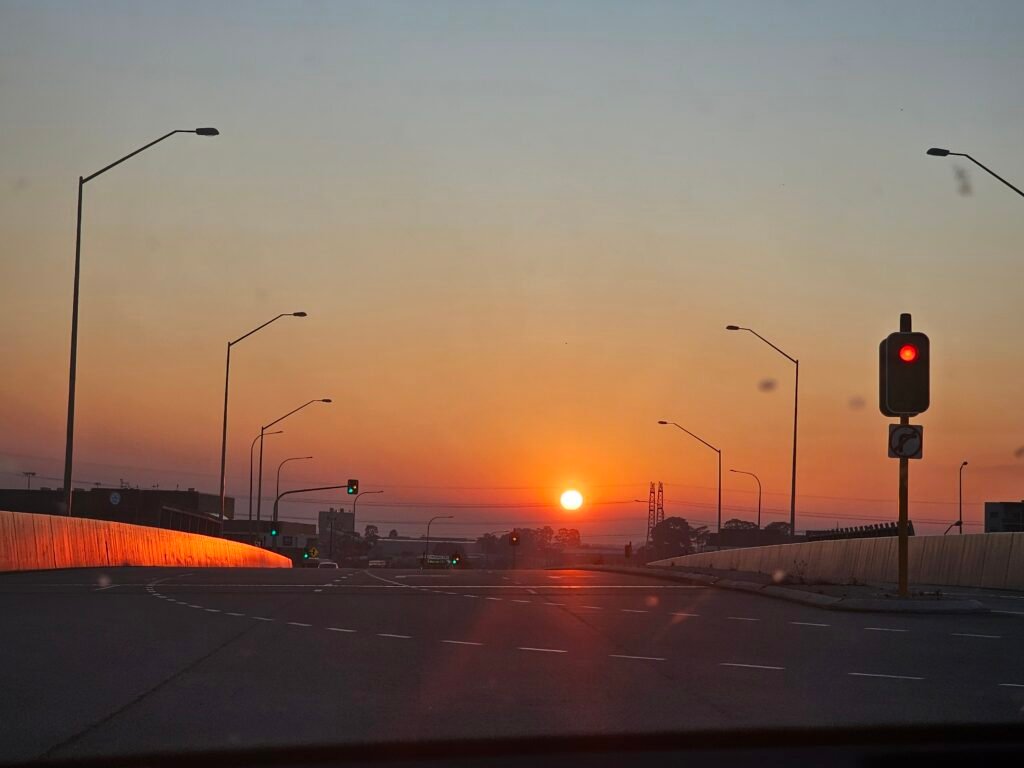
Just then, I looked up at the sky. And there it was! The
amazing pink hues of dawn (pic above), which leaves one awestruck. There it was…a moment in
time…that will stay with me forever. I was overwhelmed with gratitude. For my
life, my work and mostly, my people. The magical skies reminded me of
everything I was so thankful for. For the friend who made this doctor’s
appointment possible…For the niece and cousin who are taking a day off today to take Ma
to her appointment….For Borda and Boudi, my second set of parents…For the
friends who have stood by me through the toughest times….For the neighbours in
India who have been helpful in more ways than I can list….For the family
members who have been kind, patient and generous….For my friends in Australia
who have put up with my highs and lows…For my work, which allowed me the
flexibility, the financial freedom and the friendships needed to make a
first-generation migrant’s life less challenging than it sometimes can be. For my daughter and husband, who fill my life with joy (when they are not driving me crazy!).
Tomorrow, I may crib, cry and complain again. But today, I choose gratitude. I may not be living today as if it was the last day of my life. But I am choosing to dwell on the pink sky...not the dark clouds. Apparently,
the colour pinkrepresents caring,
compassion and love. It stands for unconditional love and understanding, and is
associated with giving and receiving care. And today’s morning sky makes me
convinced that whoever came up with that meaning, wasn’t far from the truth. I
would only add “gratitude” to it.